Chapter 131: Math and Mindset
February is here. February is a month of renewal for me, a woman who went through a sort of metaphorical death and rebirth 6 years ago after my diagnosis of incurable brain cancer. Life is different now. My perspective is different now. This blog, for those who have been with me since the beginning, or those just joining now, is a place I reflect on the joys and heartbreaks of this gifted, impermanent human life. It is a place I use to try and brings hope, motivation, awareness, and opportunity to think differently- in whatever circumstances you may be experiencing.
Over the past month, there has been chaos near my home in Minneapolis/Saint Paul brought about by a tumultuous political situation imposing harsh restrictions on our immigrant neighbors. I have hope that kindness and compassion will prevail.
I could write with anger and despair about the current political situation, but I will not. I will simply say this: I am proud of my community in Minneapolis.
Many of my friends and colleagues worked with Alex, a nurse who lost his life while trying to help a fellow community member recently. To Alex: thank you for helping so many others heal. We will remember and honor your legacy as fellow healthcare providers.
Many of my patients in Minnesota fear for their safety. Many of my favorite restaurants have shut their doors in solidarity. Many of my physician colleagues (the smartest, hardest working people I know) have to carry their passports with them while running errands. It seems impossible my safe and lovely city is experiencing this.
It is my opinion that the last thing our world needs is for a leader to encourage the nitpicking of differences in order to subjugate “others” to treatment we would not want for ourselves or our loved ones.
It is also my opinion that, as a citizen of this world, the features we share with all of humanity are vastly greater than our small differences.
I spend each February, the month of my “cancer-versary” traveling alone to someplace in the world that guarantees to take me completely out of my comfort zone. This shift in perspective every year serves as an opportunity to see that:
1) I have so much to be grateful for. My own suffering is a tiny speck compared to the many diverse magnitudes of suffering experienced around this world.
2) I know much less than I think I do. It takes a constant effort to “unlearn” and “relearn” to find the best, most compassionate version of myself. Still a work in progress (and always will be…)
3) I am an “other” to many people outside of my comfortable home community. I am always amazed at how the simplicity of sharing a wave or smile seems to transcend all differences and barriers instantly.
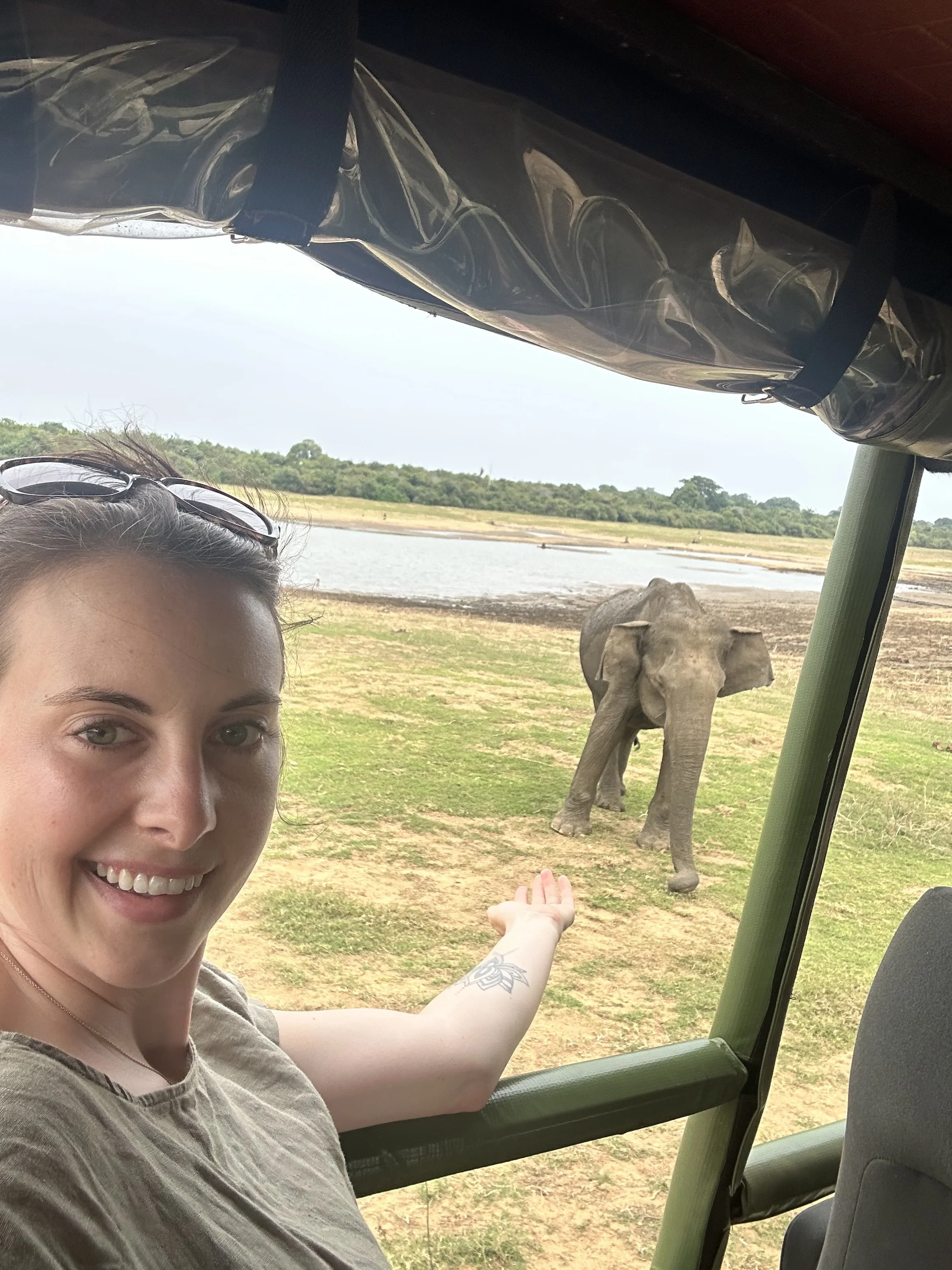
Today, I sit in Sri Lanka, a beautiful country filled with beaches, lush tropical forests, kind people, wild elephants, and a harmonious blend of cultures and spiritualities.
Here in Sri Lanka (and everywhere my February journeys have taken me- Nepal, Thailand, Bhutan, Cambodia) surrounded by a language I don’t speak, a culture I do not understand, and food I have never tasted keeps my mind open to the literal world of possibilities and experiences on our shared globe. When I think I know the answer, moving myself across this world shows me that I only know one perspective of an answer. I only know the answer that’s most visible to me. The answer I arrive at for any given question may be completely different depending on my surroundings and lived experiences.
Now, some answers seemed “fixed,” in a way. An answer to a mathematical equation, for instance, seems like it should stay largely unchanged when solved in the US or in Sri Lanka. Yet, how we arrive at this answer is taught in different ways. Why we need this answer and what we use it for changes depending on our experiences.
2+2 usually equals 4, but what about the times when it doesn’t?
If I’m losing you, give me a moment. At work a few weeks ago, I consulted another provider on an interesting case. The consultant told me not to order a test I thought was necessary for my patient. When I asked why, he said, “because 2+2 = 4.” He did not think my patient needed this test because he felt that this test would not give any new information. He assumed that she had the most likely diagnosis and did not recommend checking for less likely etiologies. I responded as politely as I could…
“But sir, we work in medicine, a field in which 2+2 does not always equal 4. We work in a field of gray, not black and white. If we think 2+2 always equals 4, we may miss diagnoses and get things wrong.”
I went on to tell him, “Had a provider said a scan is not needed because “2+2 = 4” a few years ago when I asked for an MRI of my brain, he would have been sending me home to die.”
The consultant said “noted” and hung up on me. I was floored.
I ordered the test. It did not show any new information, but I have zero regrets. It had minimal risk and the possibility of life-saving rewards. I would do it again.
I reflect on this conversation often and think about how many times I jump too quickly to “A is A” because A is usually A, or “2+2=4” because it most often is. What about when it’s not? 🤔
Before leaving on my trip to Sri Lanka, I watched ICE agents terrorize my city. I did not understand how anyone could look at another human being and treat them with such cruelty. I still don’t. But, I’m wondering if it’s perhaps similar to my consultant’s mindset: i.e. it’s easier to stick with what we know. It’s easier and more comfortable to say “2+2 = 4“ than to bring about an existential crisis wondering if our certainty (cultivated over a lifetime) may in fact represent only one possible answer of many.
In modular arithmetic and non-decimal bases, 2+2 does not equal 4. We also see this when mixing non-additive quantities (ie - if you add water that is 2∘ to water that is 2∘, your new water does not equal 4∘, it equals 2∘ due to the properties of thermal equilibrium). Look it up if and you just might experience the necessary and humbling unease I did.
Buddhist philosophy also teaches us that that 2+2 does not always equal 4, in slightly different metaphorical terms. If someone asks us what a table is, we are likely to say “it’s a table.”
However, what if we only saw the table as four legs and a piece of wood lying disconnected in a pile? Or, what if we saw the table as tree trunks still planted in the earth? What if the table is seen as tree seedlings, just starting to bud through the soil? Is that table still a table then, in each of its separate components and forms? Maybe not
I would argue that a table is what we consider a table when we look at the components with one very specific point of view.
As I sit here now, the only American I have seen today in a vast and beautiful city along the Indian Ocean, I see that I am an outsider. I am an “other.” I am a table taken out of its normal place in the dining room and tipped on its side. If I am 2+2, I equate to a different 4 here than what I do in my daily life.
These concepts are perhaps interesting to me alone. Sorry for that. If you’re still reading along with my musings, thank you! Perhaps you would enjoy reading theories on quantum physics, modular arithmetic, and dharma as I do. Haha 🤣
It’s certainly comfortable to think we know the one and only correct answer. It feels safe. It feels cozy. It feels sure.
But, when I think about the myriad of ways I might be wrong- the many limiting factors in my conclusions- I feel free.
I feel sadness for the people who jump to easy answers to solve complex problems in our society, our politics, our ecological crises, our healthcare concerns. Anger is easy to feel, but pity seems a more fitting choice when I reflect on the very limited perspectives some people live an entire lifetime with. It’s like living a life off of buttered noodles when you could add fresh pecorino and truffle!
I hope this post encourages you to feel uncomfortable for a brief period of time. Getting uncomfy in our certainty is scary, but liberating. I encourage us to be uncomfy as often as possible.
For me, these ideas help as I try to understand why some people cling so strongly to “me versus them” or “right versus wrong.” These are comfortable, easy conclusions to feel. They don’t ache as much as realizing that, perhaps more often than not, we have only considered one answer to a question with many possible explanations. Perhaps, sometimes, we are simply put- wrong. Myself most certainly included.
Reflections from a 6-year survivor of brain cancer, physician, and eternal student of life. Cheers from Sri Lanka. May you be well, may you be peaceful, may you feel compassion- for yourself and for all.
Fondly,
Courtney
©️ 2026